
Article11 min read
Why Europe is still on the drip of American hyperscalers, and what it takes to get off it
Europe runs its critical IT on American cloud platforms. Why that is still rational, why European data centres alone will not end it, and the way out.
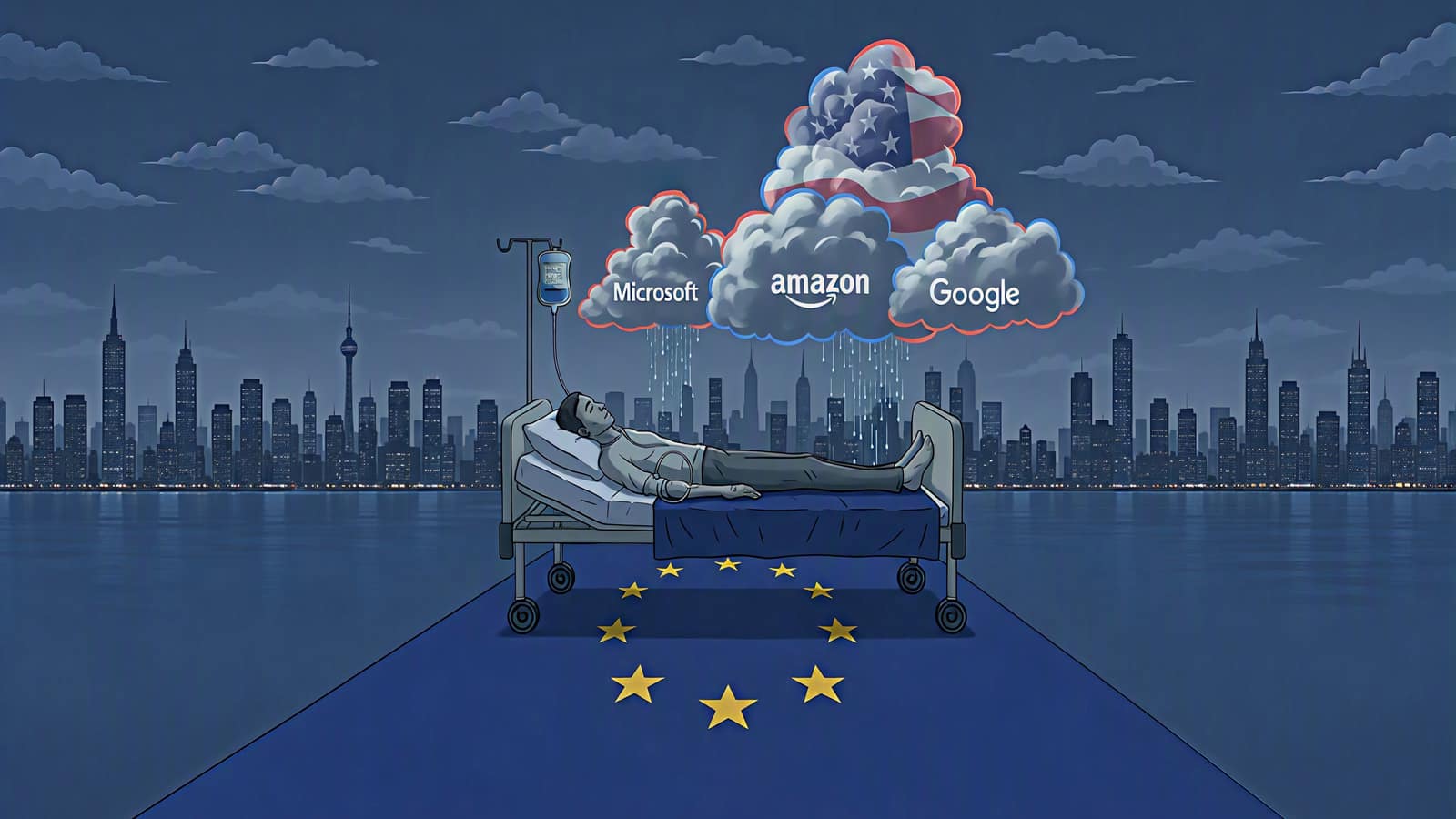
Digital sovereignty has become a mainstream debate. Governments and businesses realise that it is uncomfortable, and risky, that our critical digital infrastructure runs almost entirely on American platforms such as Microsoft, Amazon and Google. We are on a drip fed by these hyperscalers, the handful of providers that run cloud platforms at a global scale.
Yet the uncomfortable truth is that, for now, the drip is still necessary. Not because we would not like it to be different, but because Europe has simply not yet built everything it needs to be truly independent.
In this article we explain:
- why we depend on American hyperscalers today;
- why “just building a European data centre” is not enough;
- which fundamental services Europe must develop to reach real digital autonomy.
Why we are tied to American hyperscalers
The American hyperscalers do not just deliver cloud capacity. They deliver complete ecosystems:
- global scale and availability;
- very mature security and compliance processes;
- integrated development platforms, with continuous integration and delivery (CI/CD), identity and monitoring;
- and, crucially, the software that end users need every day.
Microsoft is the textbook example. Windows, Microsoft Entra ID (formerly Active Directory), Microsoft 365 and Teams are not a collection of separate products. Together they form an integrated operating system for organisations, which millions of employees use without training. That is no coincidence; it is the result of thirty years of building an ecosystem. Europe has alternatives for some of the parts, but it lacks this seamless integration of the whole.
Why depending on them is still rational today
Leaving the hyperscalers without a full alternative in place is not sovereignty, it is self-harm. Without their capabilities, the opposite of what we want happens:
- organisations lose the ability to execute and to scale;
- operational and security risks go up instead of down;
- costs rise sharply through fragmentation and the custom work it forces;
- innovation stalls because access to advanced tools, such as artificial intelligence (AI), disappears.
For critical processes, think of healthcare, energy or logistics, a “cold exit” is simply irresponsible.
That is why the only rational choice, however uncomfortable, is to keep using American cloud platforms for now while building our own capabilities in parallel. Digital independence is not a switch you flip. It is a transition path.
The misconception: “Can’t we just build European data centres?”
This misconception keeps coming back in the debate.
Yes, Europe can build excellent data centres. In fact they already exist, and they are among the greenest in the world. But a data centre is, at its core, only facilities: concrete, power, cooling and server racks.
The real dependency, and the vendor lock-in, sits in the layers above the concrete:
- the operating system (OS);
- identity and access management (IAM);
- productivity and collaboration software, delivered as software as a service (SaaS);
- scalable application platforms, delivered as platform as a service (PaaS);
- integrated development and management tools.
As long as these logical layers are American, the dependency remains in full, wherever the servers physically stand.
What Europe really needs to build
If Europe wants to become independent, it has to learn to think in stacks, not in separate products.
1. Not just compute, but an integrated fabric
An often underestimated strength of the hyperscalers is the so-called cloud fabric: the deeply integrated layer in which compute, network and security form one intelligent whole.
In Azure or Amazon Web Services (AWS) this is the standard:
- network segmentation is built into the platform;
- firewalling and routing are software-defined and centrally controlled;
- identity, network and security are connected seamlessly through policies;
- best practices are enforced automatically, compliance by default.
For IT teams that makes a world of difference:
- far less manual, error-prone configuration;
- no need to redesign the infrastructure for every project;
- predictable behaviour, even at very large scale.
This stands in sharp contrast with traditional data centres, where network, storage and security are often still separate disciplines, each with its own team, its own tools and risky hand-overs between them.
The conclusion: a European alternative cannot stop at delivering servers and storage. It must also deliver:
- a standardised network fabric;
- integrated security concepts;
- policy-driven configuration as the default.
2. A complete, independent European workspace stack
This is not about one application, but about a complete, coherent software ecosystem that can replace the American workplace. The minimum requirements for such a stack are:
- A sovereign operating system concept. Not necessarily one single operating system, but an open standard that is independent of American kernels such as those of Windows or macOS.
- An independent identity layer. A European alternative to Active Directory and Microsoft Entra ID. This is the key to access and to data.
- Productivity and collaboration. Full alternatives to Office and Teams: documents, mail, chat and video.
- Unified device management. The ability to manage and secure laptops and mobile devices, the alternative to Microsoft Intune.
- Security by design. Built-in compliance with European Union (EU) regulation, not an afterthought.
Crucially, all of this must work without any dependency on American clouds, licence models or proprietary kernels.
But even if we manage to build this technically, it is still not enough.
3. A living ecosystem, not an empty software framework
A software platform only earns its right to exist when third parties actively build on it: independent software vendors (ISVs), builders of cloud services and integrators.
The hyperscalers understand this mechanism like no one else. For decades they have invested billions in their partner networks through:
- high-quality development platforms, software development kits (SDKs) and application programming interfaces (APIs);
- extensive documentation and reference architectures;
- global marketplaces for direct sales;
- aggressive commercial incentives for partners.
This creates a self-reinforcing effect, a flywheel: the more applications, the more attractive the platform is for customers, and the harder it becomes for those customers to leave.
For a European alternative the same mechanism applies, but as a chicken-and-egg problem. Without a critical mass of applications:
- businesses will not adopt the platform (“nothing runs on it”);
- developers stay away (“there are no customers”);
- there is no economic basis for innovation.
Third parties must therefore not only be asked, but actively motivated to develop for the new European stack. That requires:
- APIs that are guaranteed to be stable and open;
- predictable roadmaps, not policy that zigzags;
- attractive business models for partners;
- one scalable digital single market instead of 27 fragmented ones.
You do not build this in quarters. It takes years.
4. Phasing out the dependency on American operating systems
As long as our organisations keep running on proprietary American operating systems, the whole ecosystem remains fundamentally dependent, wherever the applications or the data reside.
Real independence therefore also means daring to go deep:
- a controlled reduction of the dominance of Windows and other American operating systems;
- investment in European operating system standards for workplaces and servers, based on open source or on European proprietary software;
- making sure core applications run fully on these new standards.
This is not a plea for an abrupt, reckless break, but it is a plea for a clear course. As long as that point on the horizon is missing, third parties will never invest seriously in a European platform.
5. Ease of use at the level of Windows
This may be the hardest hurdle of all. Technically, Europe can build anything. Where it often fails is the “soft” side:
- a consistent user experience (UX);
- a very low barrier to adoption;
- predictable management for IT departments;
- the refinement that only years of development bring.
An alternative that is “technically safer” but harder to use will never be adopted widely. People do not accept “ideological software” that slows down their daily work.
A European alternative must therefore:
- work as smoothly as Windows or macOS;
- feel as natural as Microsoft 365;
- be as easy for administrators to roll out and manage centrally.
Without that user experience, every initiative is doomed from the start.
6. Scale, governance and stamina
The hyperscalers were not built in five years. They have existed for decades and invest tens of billions in their ecosystems every year.
What Europe needs to reach that level:
- public-private cooperation, not only government initiatives;
- European investment power at the level of the hyperscalers;
- shared standards across borders, not national islands;
- governance that enables innovation instead of stifling it.
This is not a start-up project and not a three-year subsidy programme. It is digital infrastructure on the scale of a civilisation, comparable to building the railways or the electricity grids of the last century.
Regulation: not a brake, but an accelerator
In his 2024 report on European competitiveness, Mario Draghi made the point sharply: the weight and fragmentation of European regulation hold back the companies that Europe needs to grow. The intentions are usually good, privacy, safety and consumer protection, but the balance too often tips towards risk avoidance and fragmentation. For digital sovereignty, that is fatal.
If Europe loads every new initiative in advance with:
- complex and overlapping compliance requirements;
- national exceptions (“gold-plating”);
- legal uncertainty;
- and years of decision-making,
then the winner is not the most innovative party, but the one with the deepest pockets and the most lawyers. And that is exactly the field on which the American hyperscalers, with their armies of compliance officers, excel.
What Europe needs is not deregulation, but smart regulation:
- clear, firm boundaries at the edges;
- maximum room and freedom in the middle;
- one open single market without digital borders.
Innovation does not happen in airtight policy documents, but in markets where:
- ideas can be tested quickly, in regulatory sandboxes;
- growth is possible without starting over in every country;
- failure is allowed, as long as the basic rules are clear.
Without that breathing space, no European ecosystem will ever build the momentum needed to match the established players.
Interoperability as a condition for the transition
An often underestimated aspect of the sovereignty debate is interoperability. Not as an ideal, but as a hard condition for a realistic transition.
As long as European alternatives cannot work seamlessly with the existing hyperscaler environments, such as Azure and AWS, organisations face a forced all-or-nothing choice. And risk-aware organisations simply do not dare, and cannot afford, to make that choice.
In concrete terms, interoperability means:
- Data portability. Data can be exchanged easily and without loss.
- Identity federation. Identities can be linked seamlessly between environments.
- Network integration. Environments can be connected without complex redesigns.
- Hybrid architecture. Applications can run in hybrid and multi-cloud scenarios.
- Unified governance. Management and security policies apply consistently across all platforms.
The hyperscalers themselves used interoperability cleverly to speed up their adoption: you could start small, integrate with your own on-premises environment as a “hybrid cloud”, and only migrate fully later.
Exactly the same mechanism applies to European solutions. Without strong interoperability:
- the move becomes too risky to operate (“big bang” migrations);
- programmes become unaffordable;
- and the dependency stays, out of pure fear of disruption.
Interoperability is therefore not a technical detail, but the strategic lever to reduce vendor lock-in in a controlled way, step by step.
The realistic way forward
The road to independence is not black and white. It is not a choice between “everything in the cloud now” and “everything back to the basement”. The realistic route runs on two tracks at once:
- Use the hyperscalers deliberately, now. Use them in a controlled way for what they do best today, scale and innovation, and be aware of the risks.
- Invest in alternatives. At the same time, build European capacity on the strategic layers: identity, data and AI.
- Demand interoperability. Make it a hard design requirement in every procurement, not an afterthought.
- Use open standards. Use them to make future vendor lock-in technically impossible.
- Regulate smartly. Use legislation to drive innovation and shape markets, not only to brake on risk.
- Migrate step by step. Move functionality to a sovereign platform only when an equivalent alternative exists.
You do not pursue this policy out of emotion or ideology, but out of technical and economic reality.
In closing
We are on the drip of the American hyperscalers. That is not a sign of weakness, but the logical result of choices Europe postponed in the past.
Pulling the drip out abruptly now would be a capital mistake: the patient would not survive. The only right choice is to build, now and with urgency, a European, independent software ecosystem that is:
- technically mature;
- easy to use for everyone;
- scalable far beyond national borders;
- and economically competitive.
Only then, and not before, can we responsibly let go of the drip.
At Synergetic IT we look at cloud strategy with that reality in mind: sober, technical and without ideology, but with a sharp eye on the future. In practice that means using the hyperscalers where they are strongest, keeping the keys to your data under your own control, and designing every environment so that you can move when a real alternative exists.
See what we offer in private and hybrid cloud and senior consultancy and interim IT leadership.